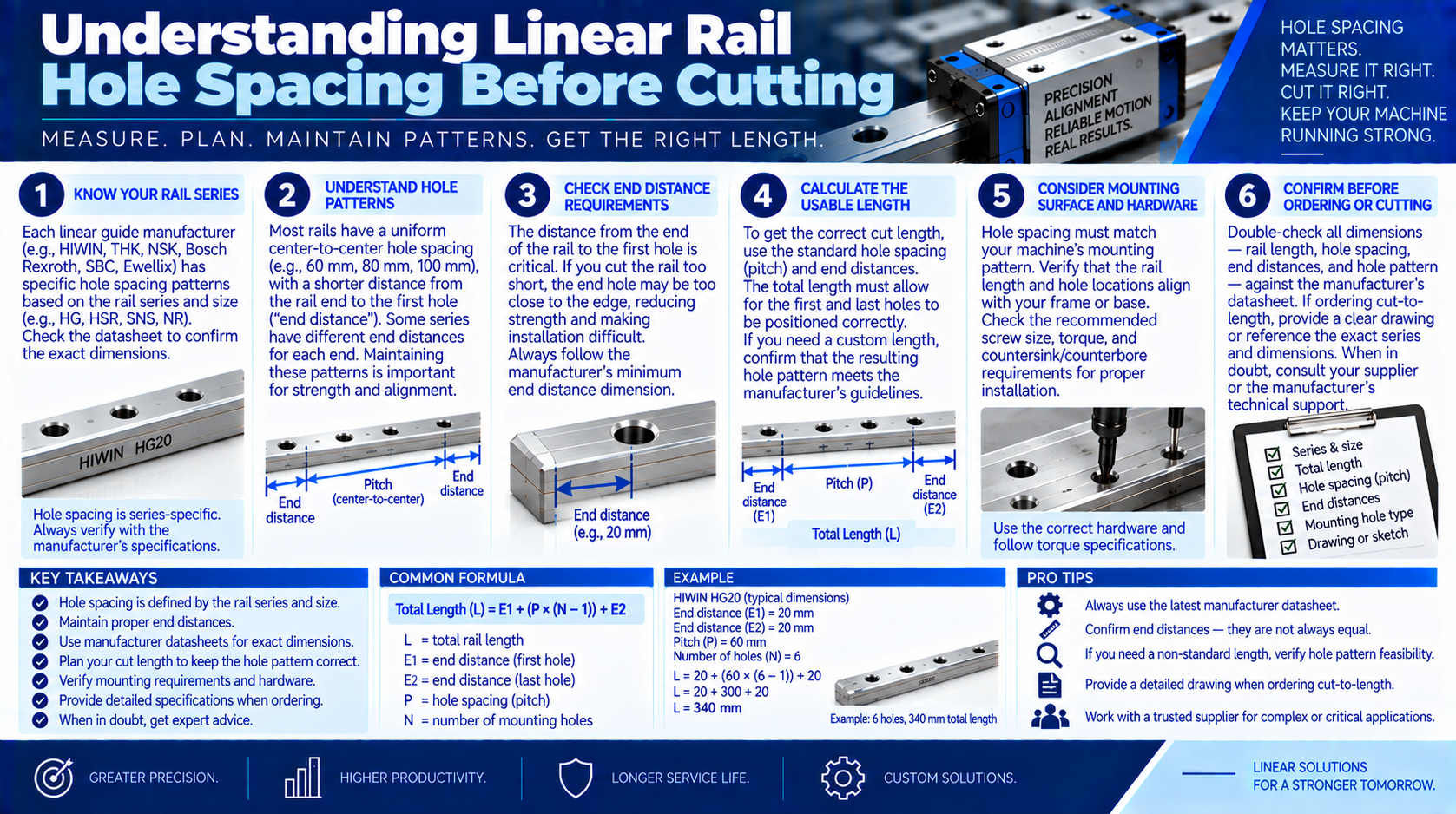
Understanding Linear Rail Hole Spacing Before Cutting
Understand linear rail hole spacing before cutting, including mounting-hole pitch, G1 and G2 end dimensions, hole count, finished rail length, and how to avoid creating a rail that will not match the machine.
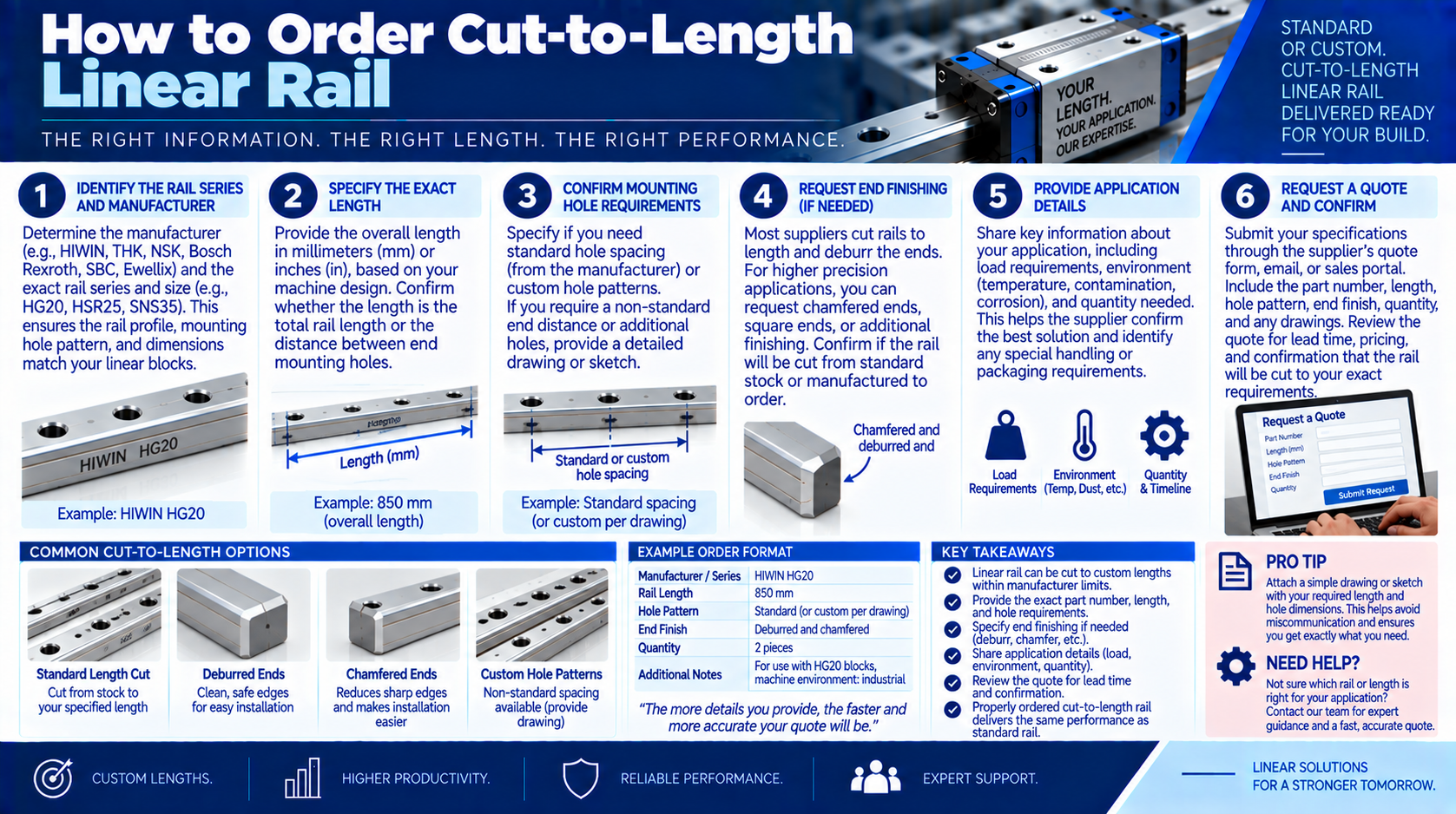
How to Order Cut-to-Length Linear Rail
Learn what information to provide when ordering cut-to-length linear rail, including finished length, mounting-hole pitch, end dimensions, stroke, block spacing, accuracy, quantity, and replacement geometry.
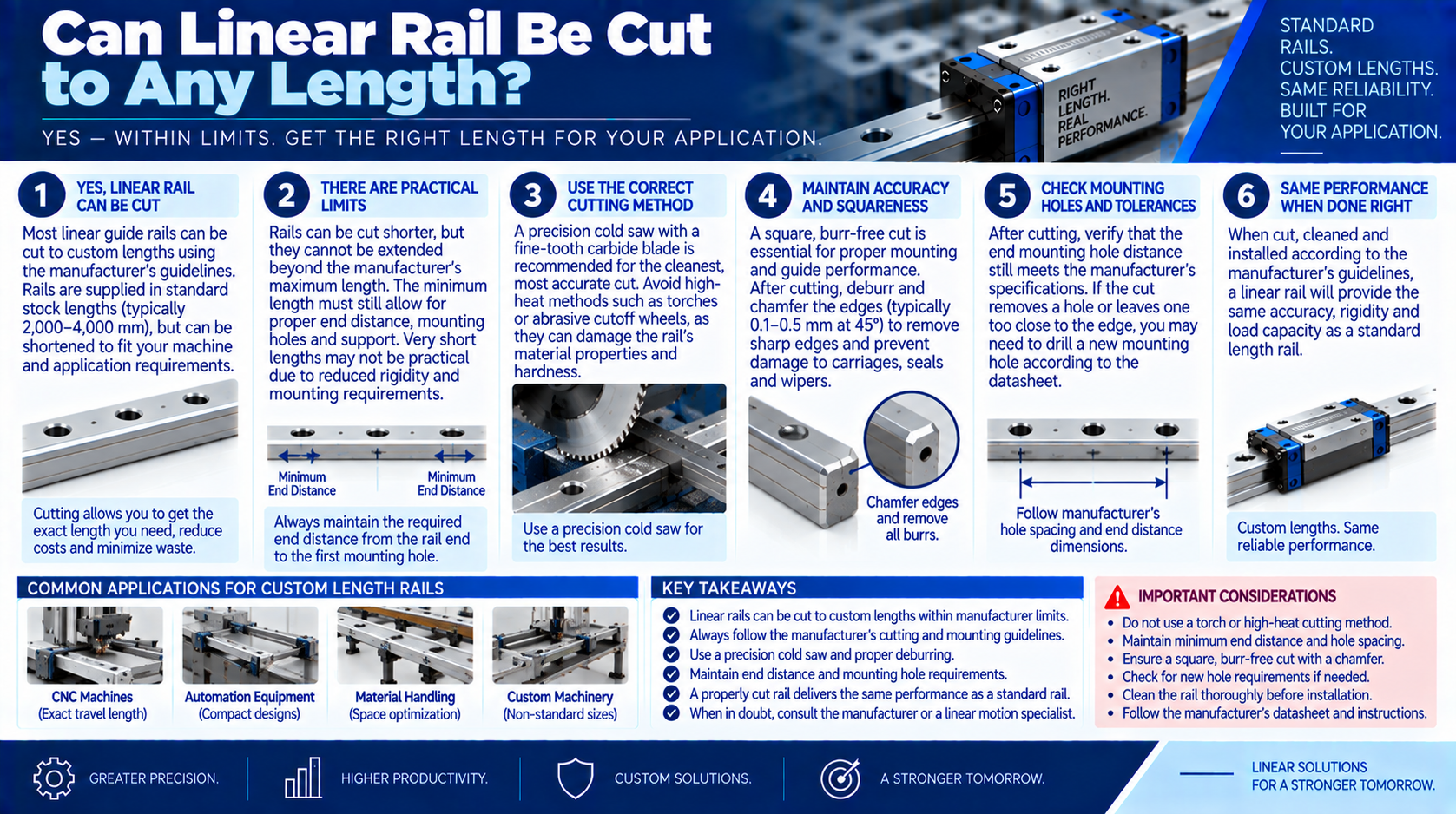
Can Linear Rail Be Cut to Any Length?
Linear rail can be custom cut to many lengths, but mounting-hole pitch, end dimensions, required stroke, carriage spacing, and manufacturer maximum rail length determine which finished dimensions make engineering sense.
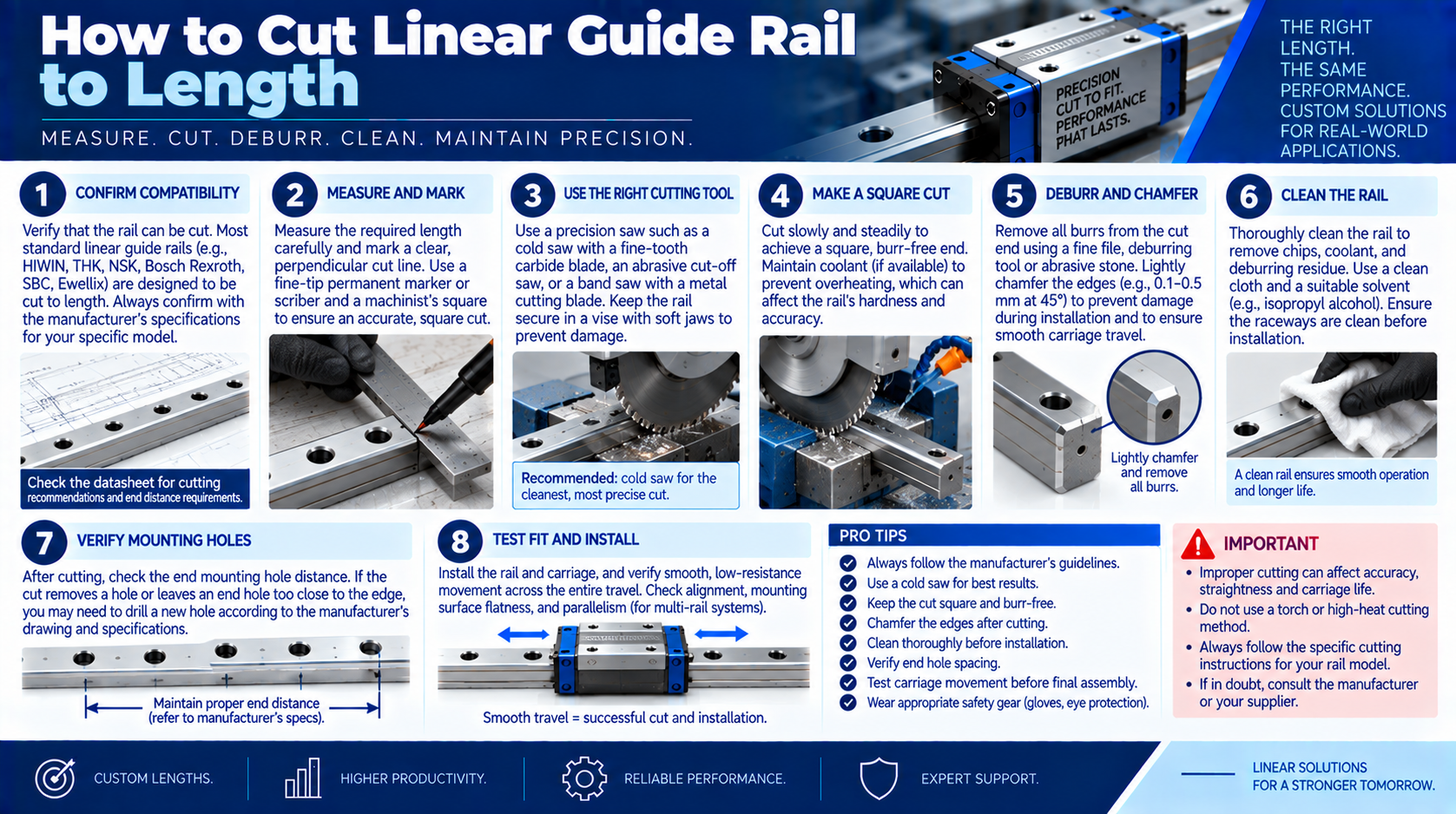
How to Cut Linear Guide Rail to Length
Learn how to cut linear guide rail to length while protecting hardened raceways, planning mounting-hole pitch and end dimensions, deburring the cut, and preserving the rail geometry required for smooth installation.
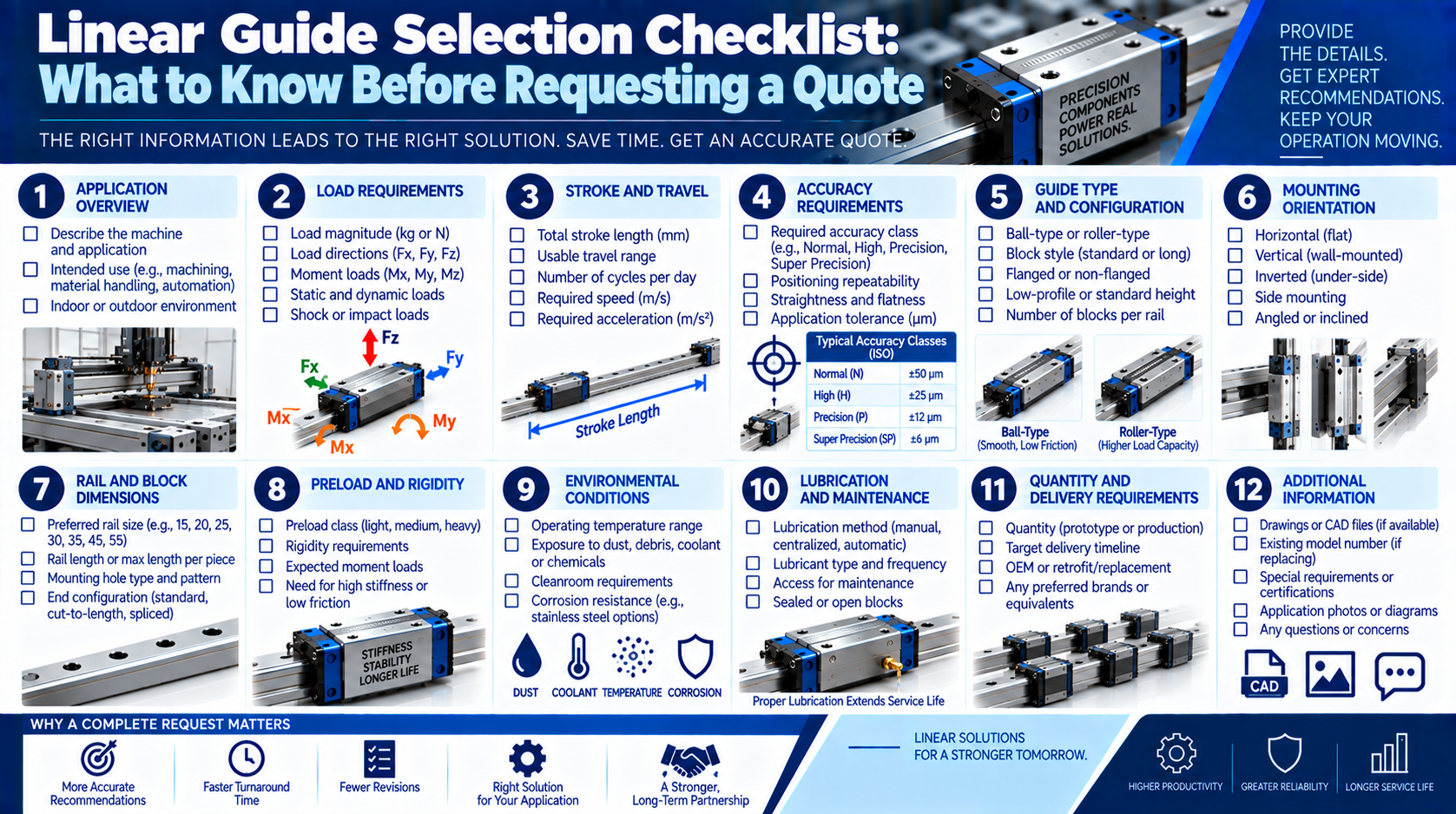
Linear Guide Selection Checklist: What to Know Before Requesting a Quote
Use this linear guide selection checklist to gather the load, center of gravity, mounting orientation, rail and block spacing, stroke, speed, acceleration, accuracy, life, environment, and rail dimensions needed before requesting a quote.
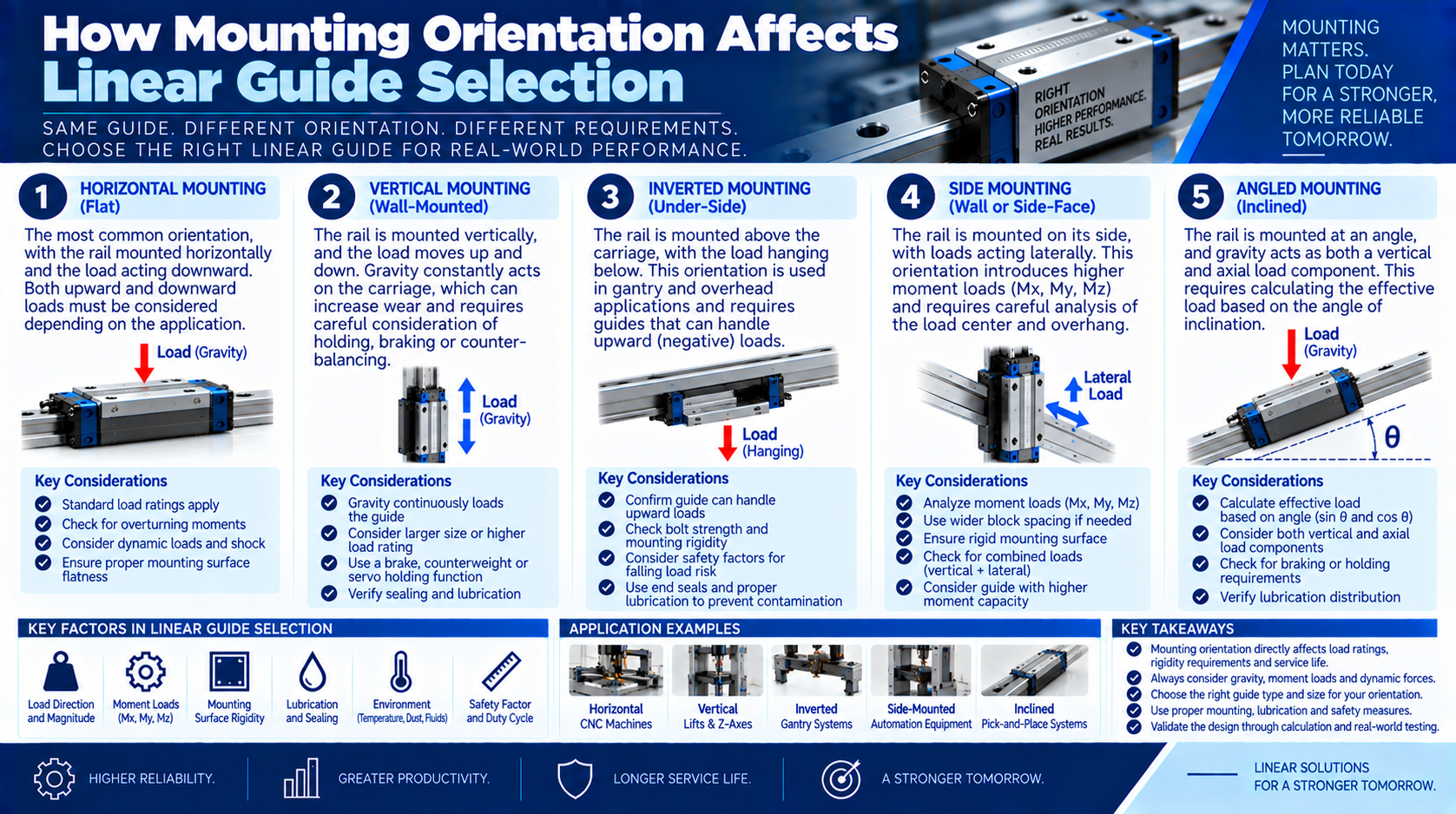
How Mounting Orientation Affects Linear Guide Selection
Learn how mounting orientation changes linear guide loading, moments, directional capacity, lubrication, and life—and what to check when mounting guides horizontally, vertically, inverted, on a wall, or at an angle.
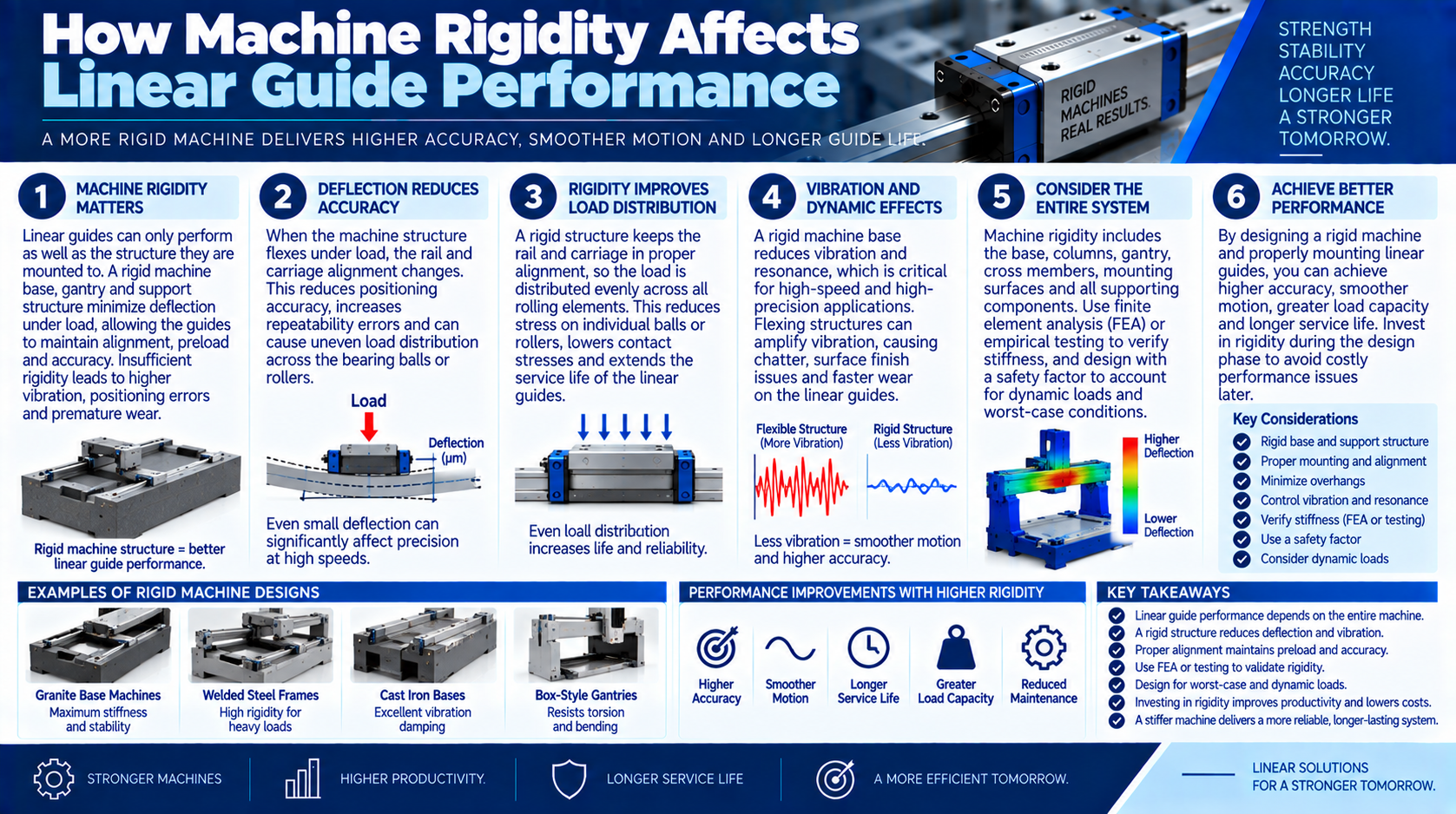
How Machine Rigidity Affects Linear Guide Performance
Learn how machine rigidity affects linear guide deflection, carriage loading, accuracy, vibration, preload, rail and block spacing, and service life—and why a rigid guide cannot compensate for a flexible machine structure.
Linear Guide Selection for Long-Stroke Applications
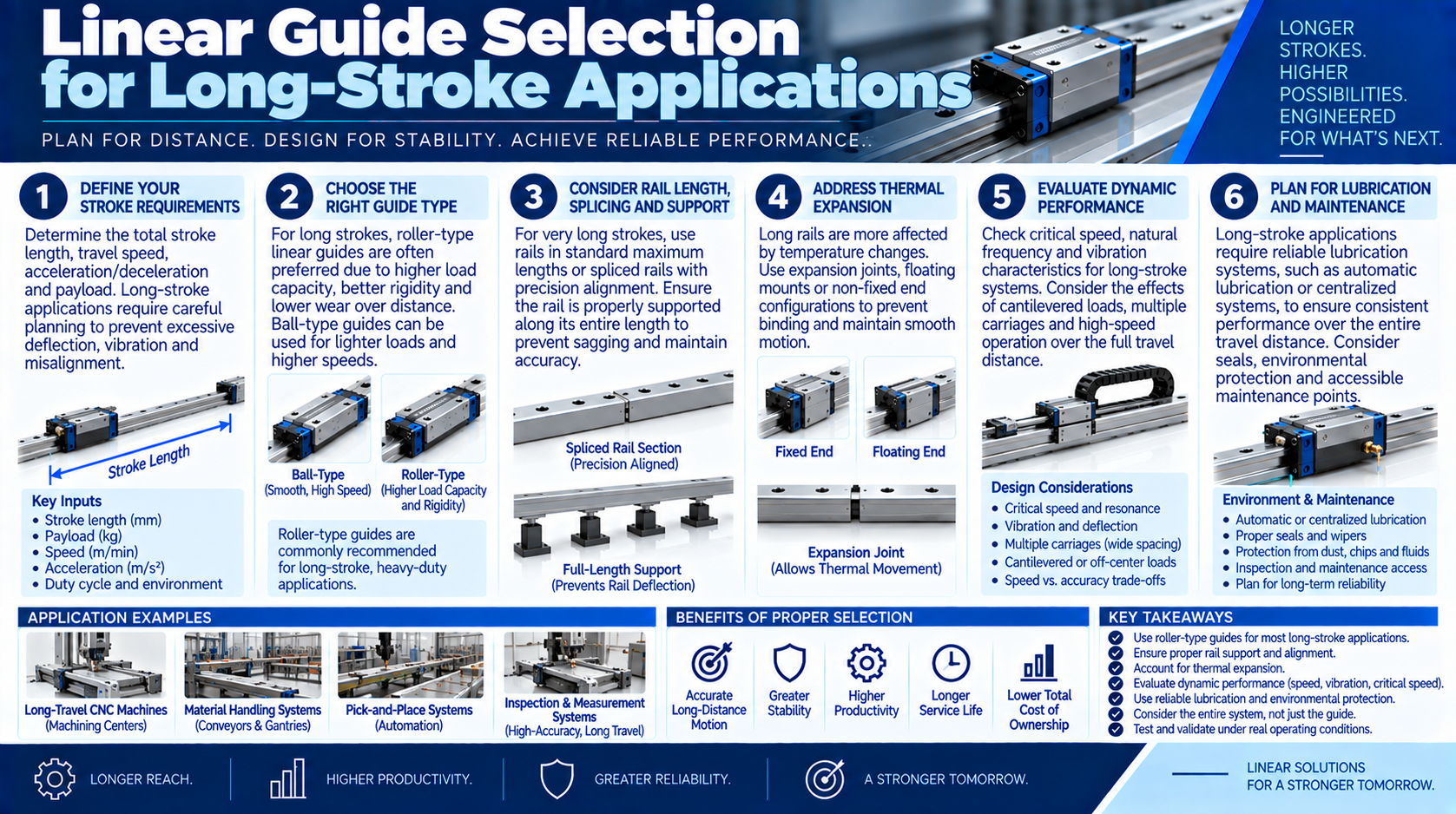
Learn how to select linear guides for long-stroke applications by planning usable travel, total rail length, jointed rails, mounting-hole geometry, alignment, lubrication, thermal growth, and lifetime travel.
Choosing Linear Guides for Heavy Loads
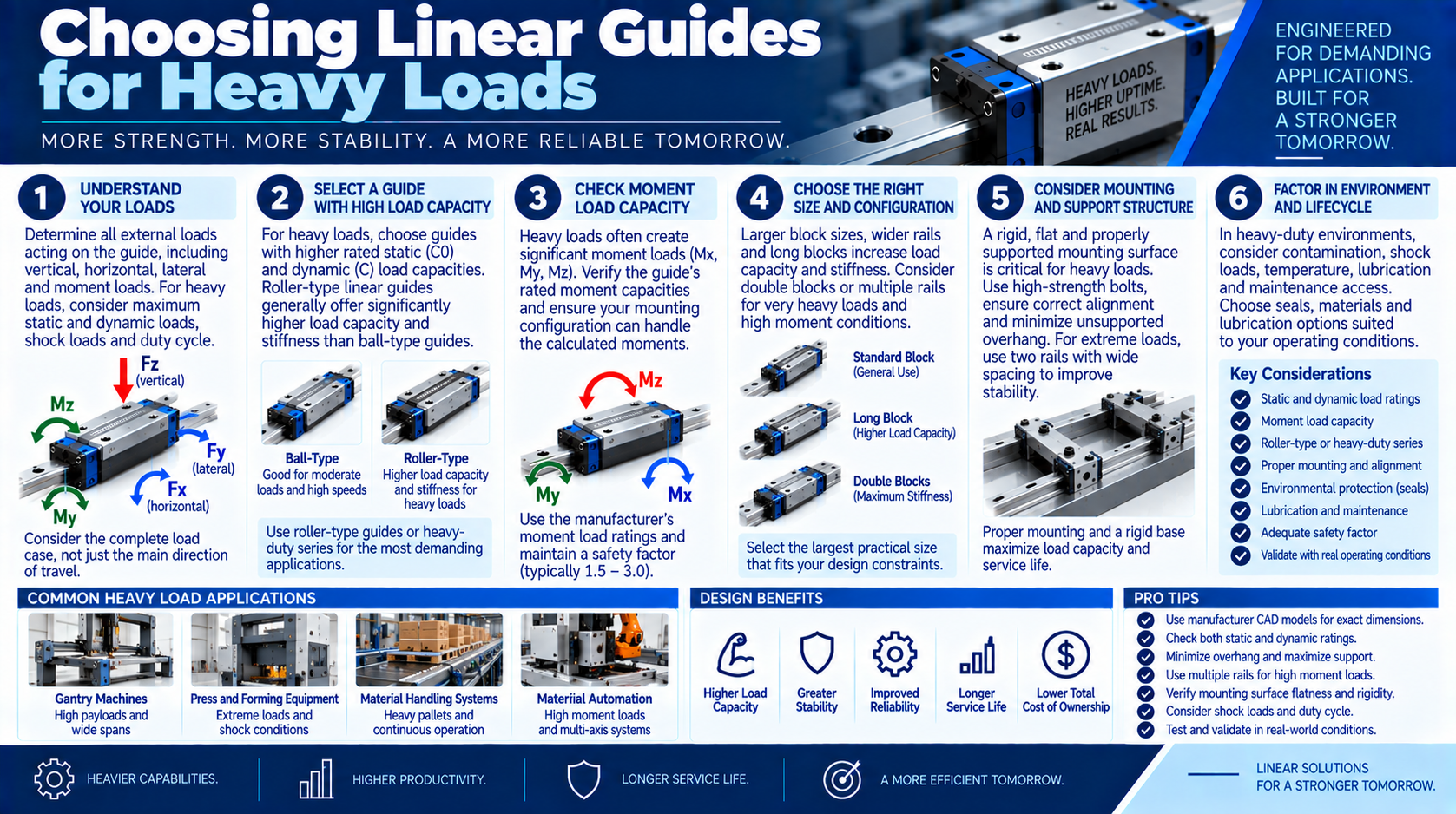
Choose linear guides for heavy loads by calculating individual carriage forces, static and dynamic ratings, moment loads, rigidity, rail and block spacing, preload, and required life.
Choosing Linear Guides for High-Precision Applications
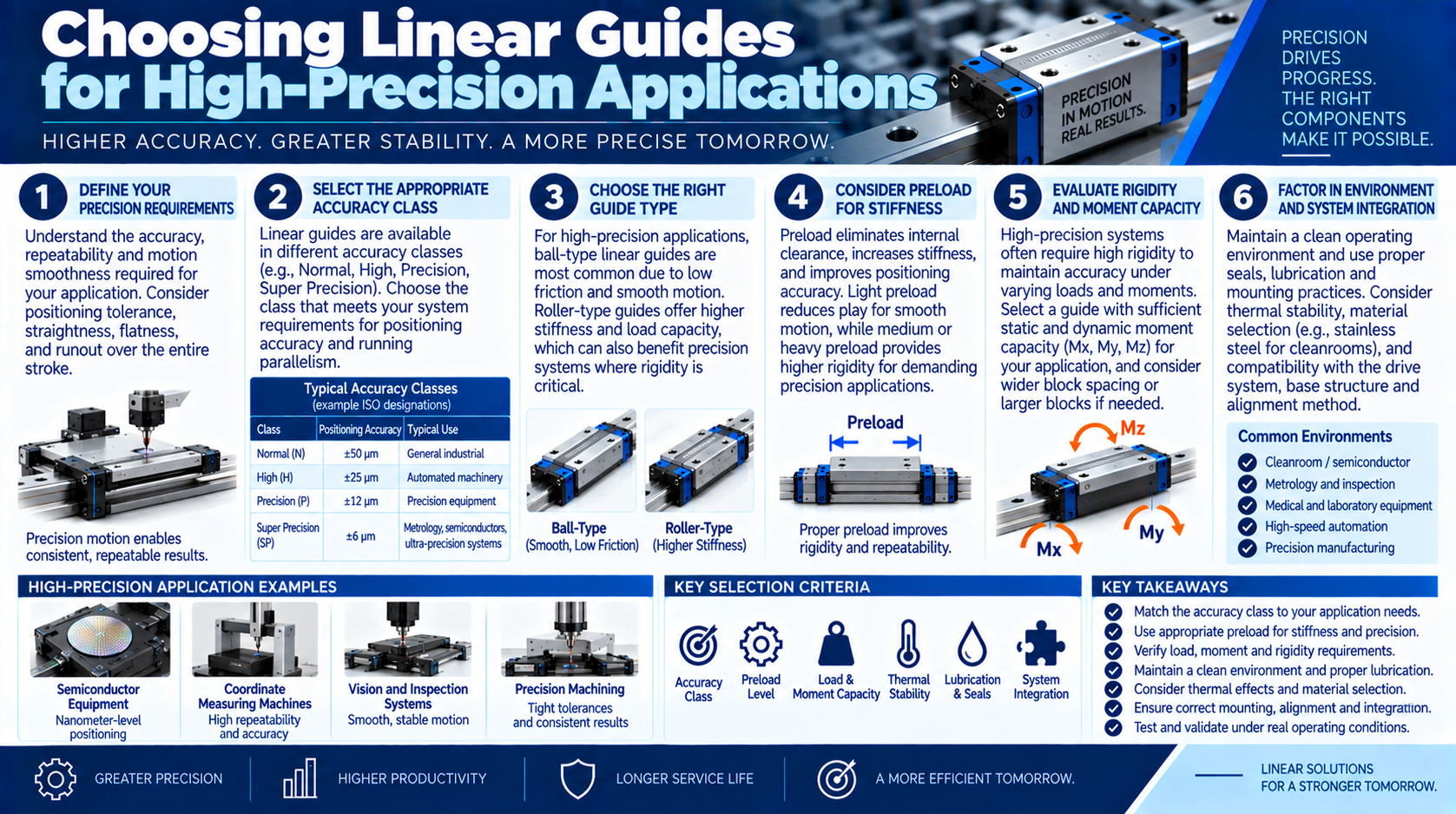
Learn how to choose linear guides for high-precision applications based on accuracy class, preload, rigidity, mounting tolerances, rail and block spacing, thermal stability, and load.
Choosing Linear Guides for High-Speed Applications
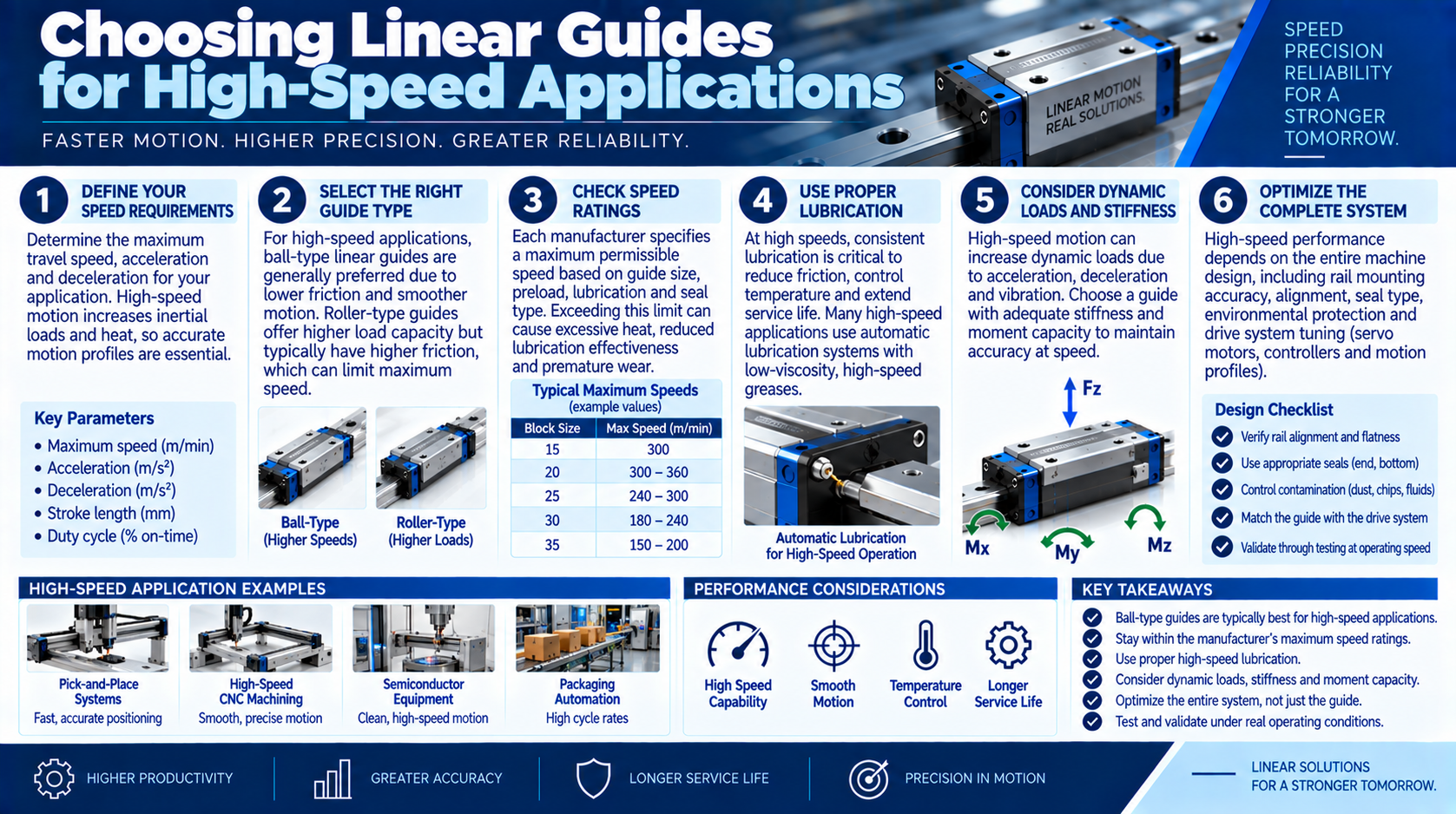
Learn how to choose linear guides for high-speed applications based on velocity, acceleration, moving mass, preload, lubrication, heat, rigidity, mounting accuracy, and guide life.
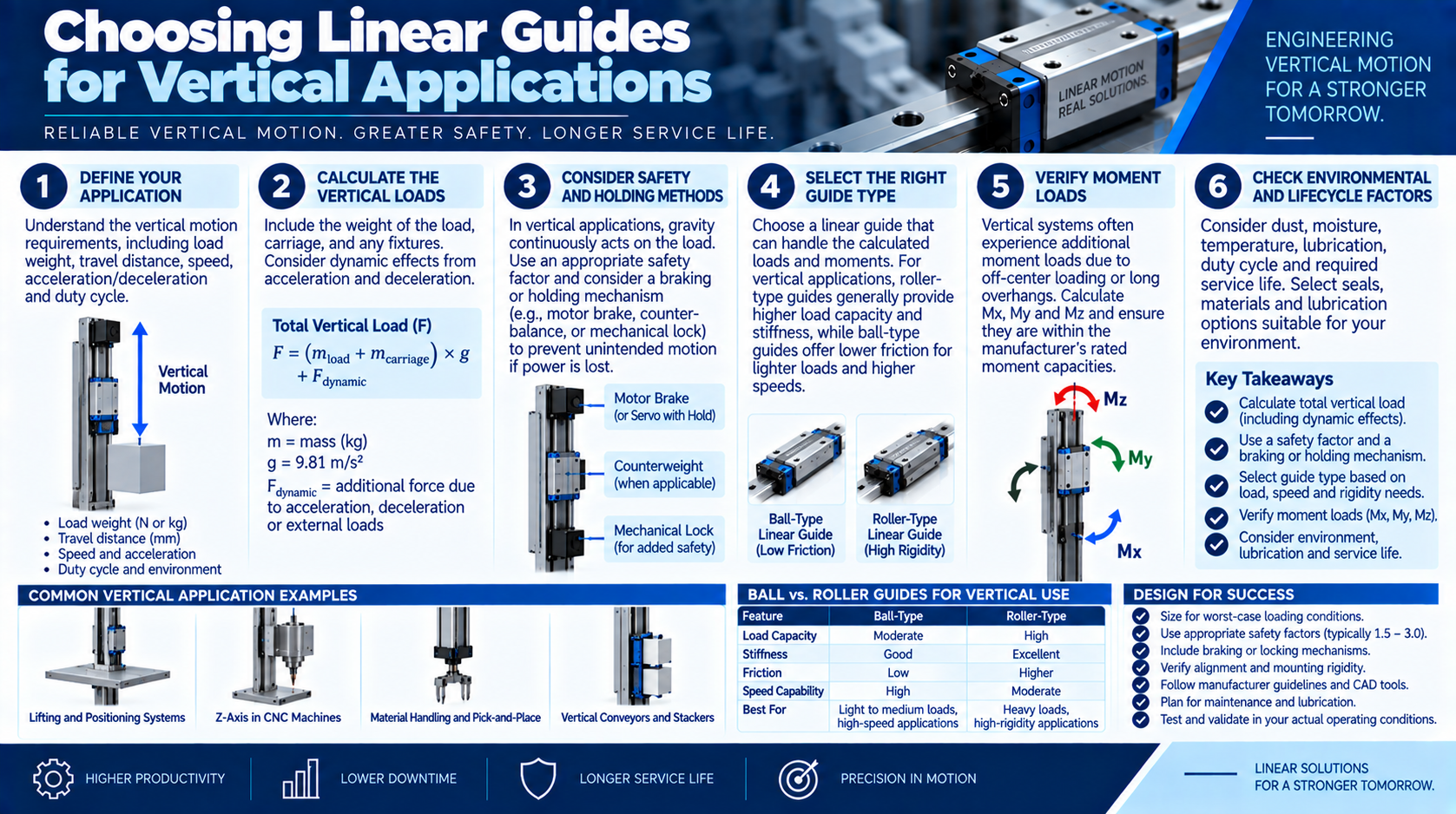
Choosing Linear Guides for Vertical Applications
Learn how to choose linear guides for vertical applications, including gravity, center-of-gravity offset, moment loads, rail and block spacing, rigidity, life, lubrication, and vertical-axis holding safety.
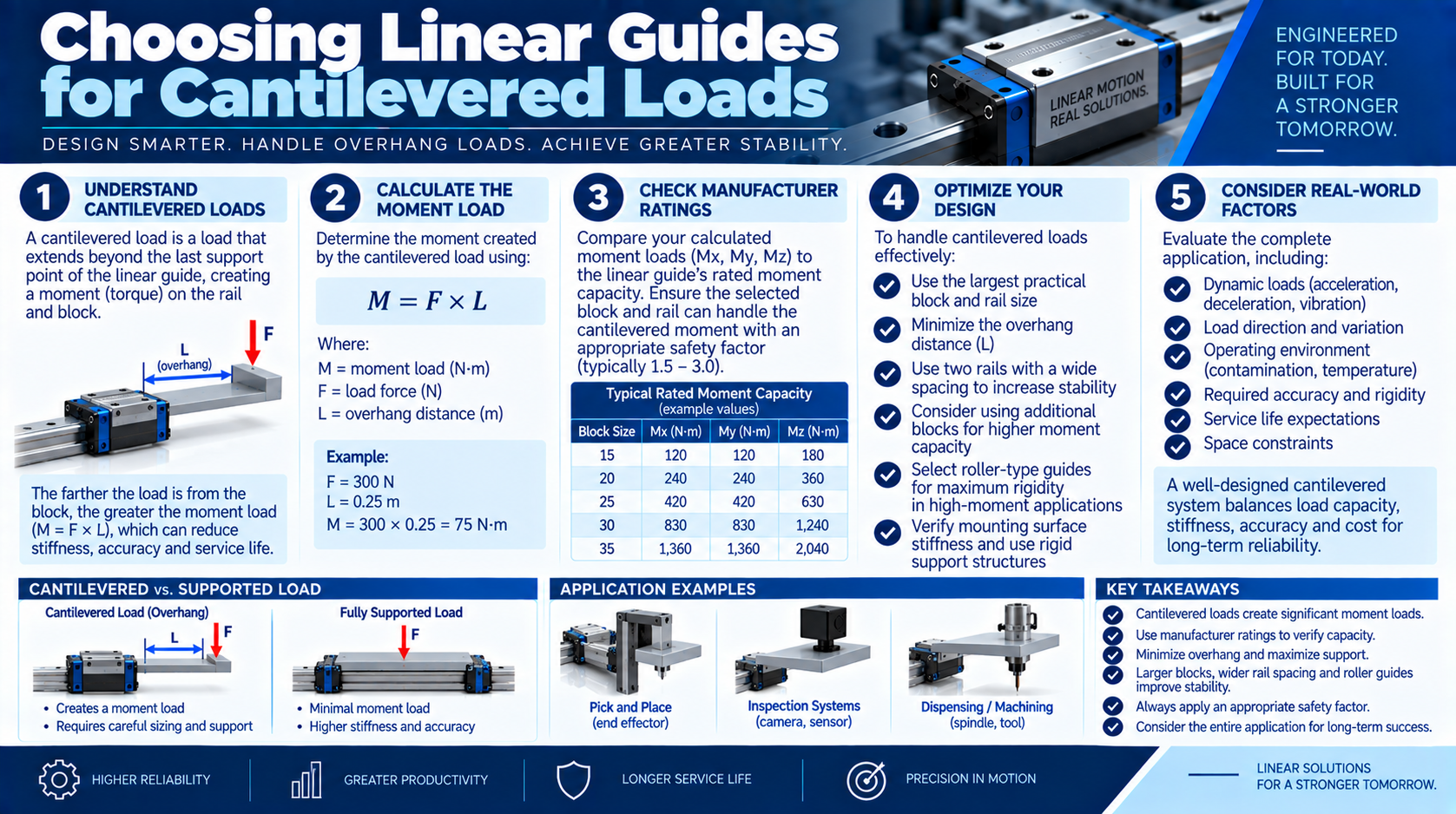
Choosing Linear Guides for Cantilevered Loads
Learn how to choose linear guides for cantilevered loads by calculating overhang moment, carriage reactions, rail and block spacing, static safety, rigidity, and fatigue life.
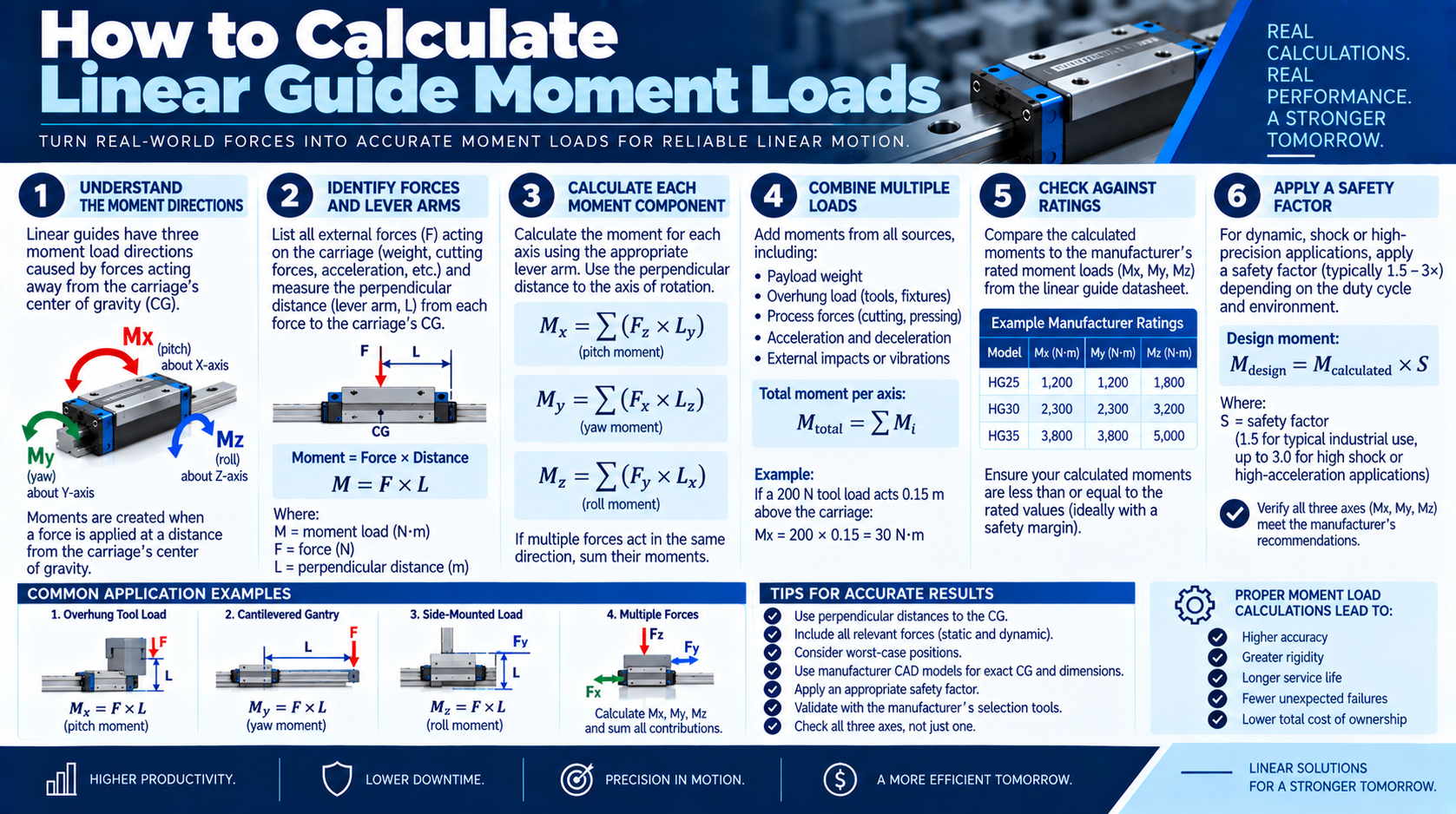
How to Calculate Linear Guide Moment Loads
Learn how to calculate linear guide pitch, yaw, and roll moment loads using force, offset distance, rail spacing, block spacing, and individual carriage reactions.
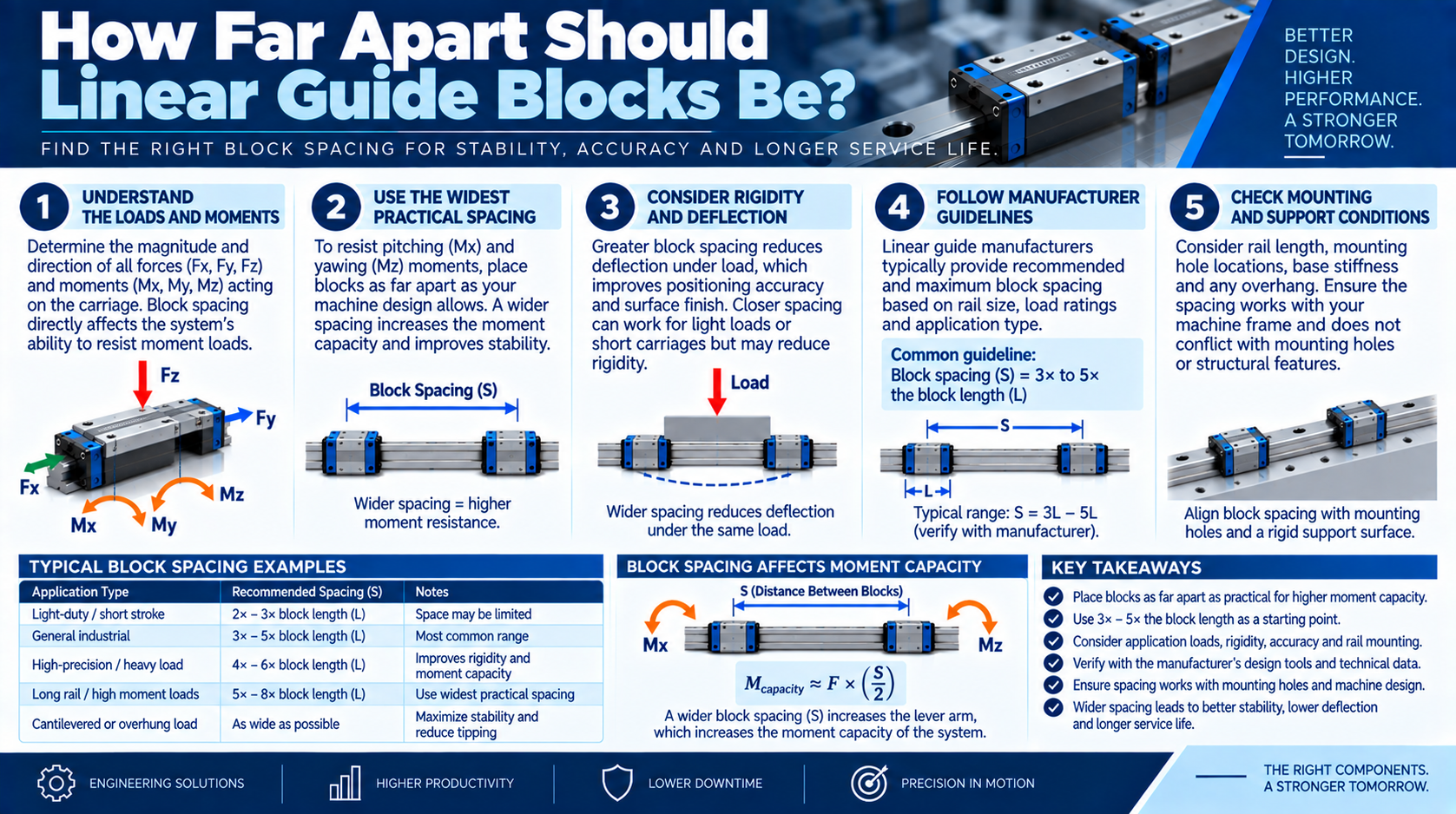
How Far Apart Should Linear Guide Blocks Be?
Learn how far apart linear guide blocks should be and how carriage spacing affects pitch and yaw moments, block loads, rigidity, fatigue life, rail length, and usable stroke.
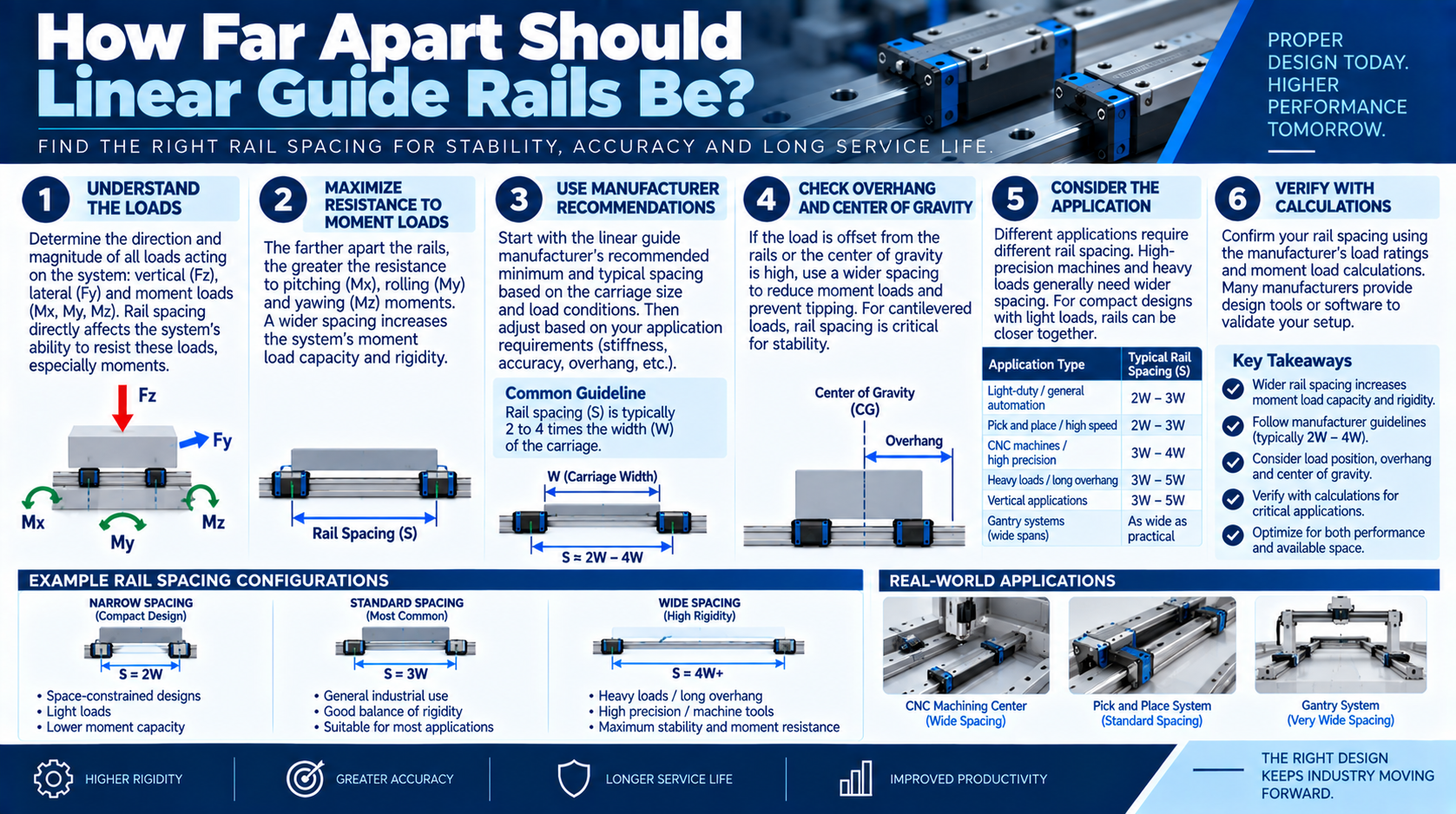
How Far Apart Should Linear Guide Rails Be?
Learn how far apart linear guide rails should be and how rail spacing affects roll moment, carriage load, rigidity, fatigue life, center of gravity, and machine design.
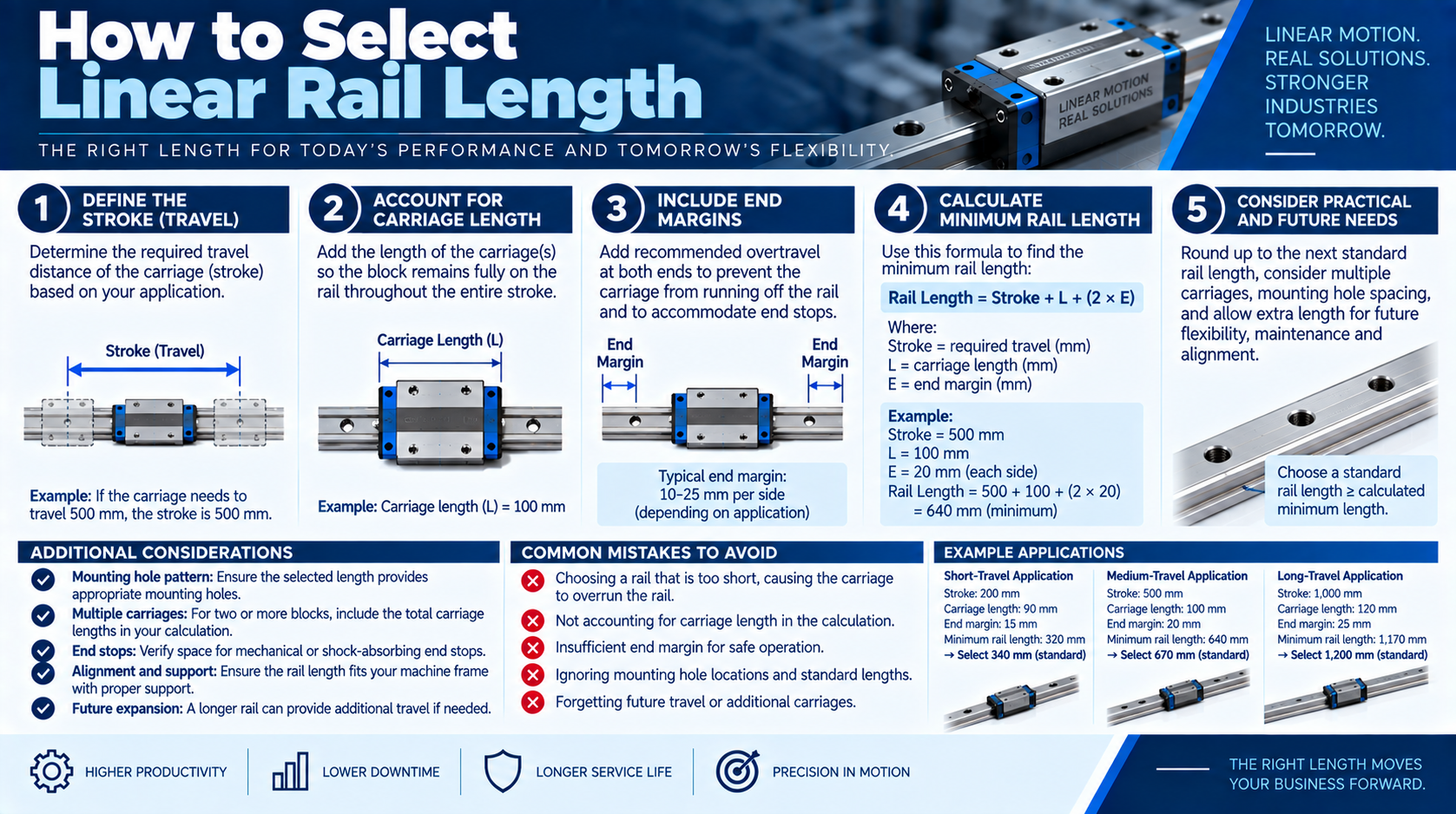
How to Select Linear Rail Length
Learn how to select linear rail length from required stroke, carriage length, block spacing, mounting-hole pitch, G1/G2 end dimensions, and maximum rail length.
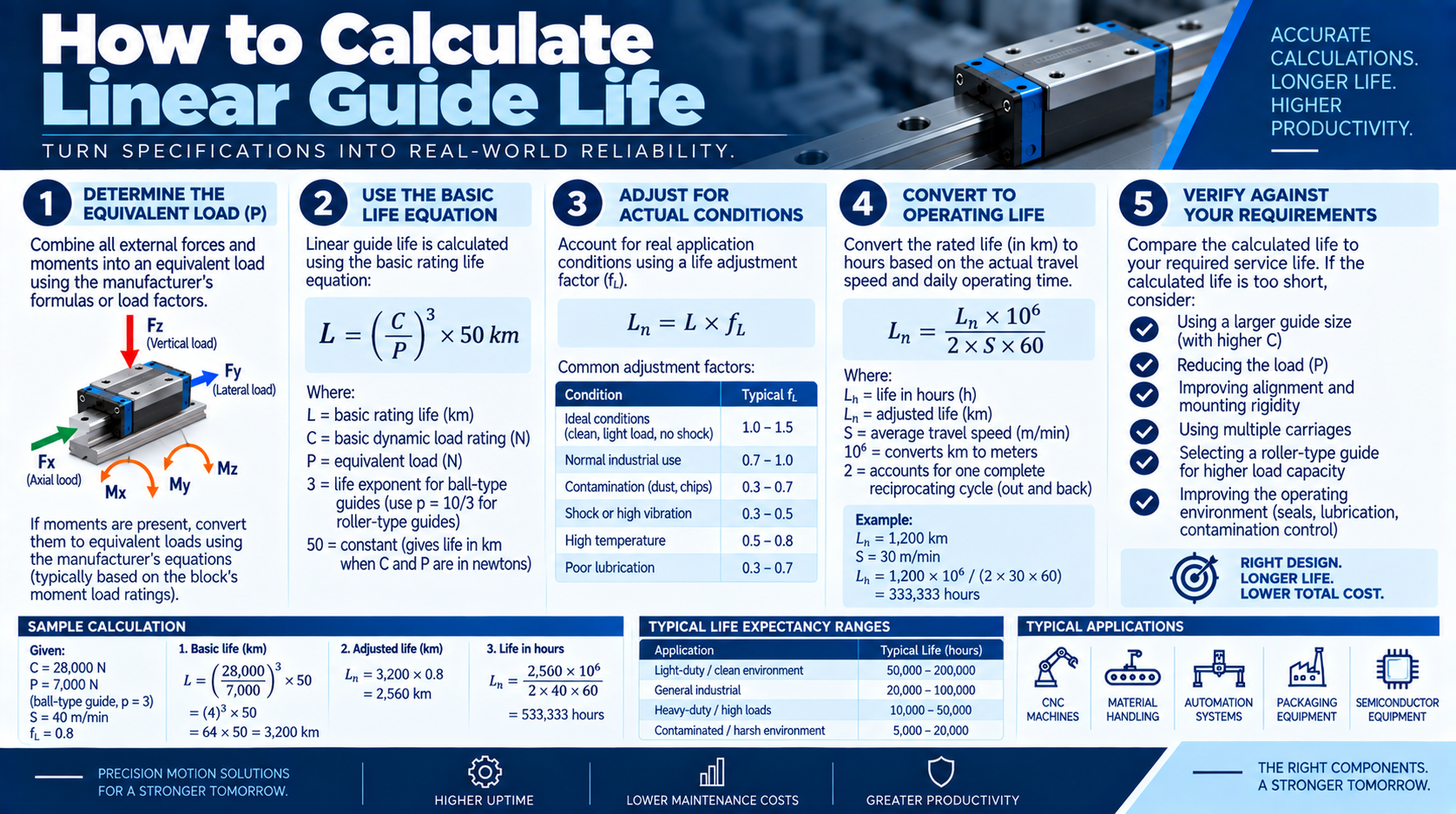
How to Calculate Linear Guide Life
Learn how to calculate linear guide life using dynamic load rating C, equivalent carriage load, L10 formulas, ball vs. roller equations, duty cycle, and operating hours.
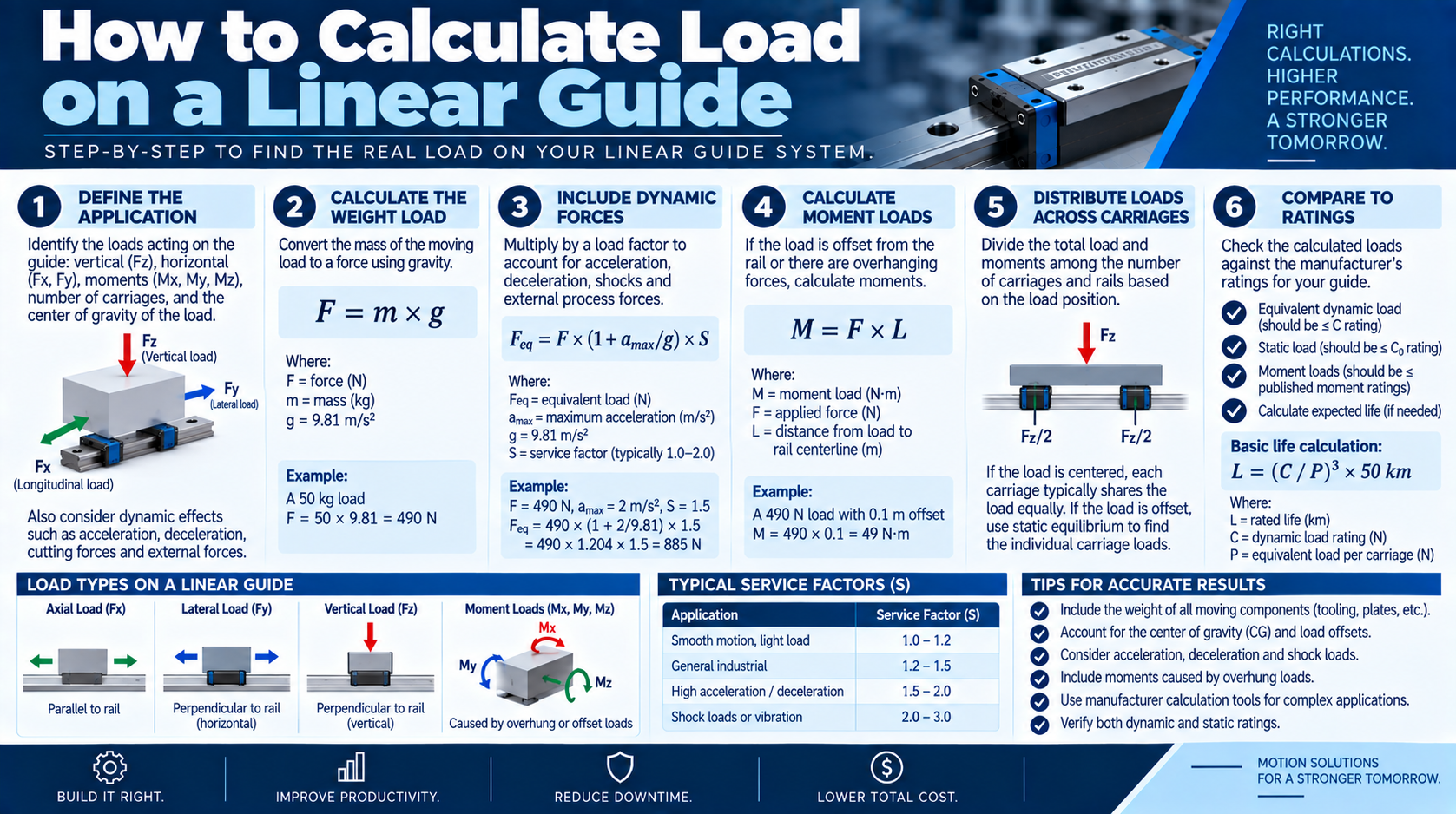
How to Calculate Load on a Linear Guide
Learn how to calculate linear guide load using mass, acceleration, center of gravity, pitch, yaw, roll, rail spacing, block spacing, and individual carriage reactions.
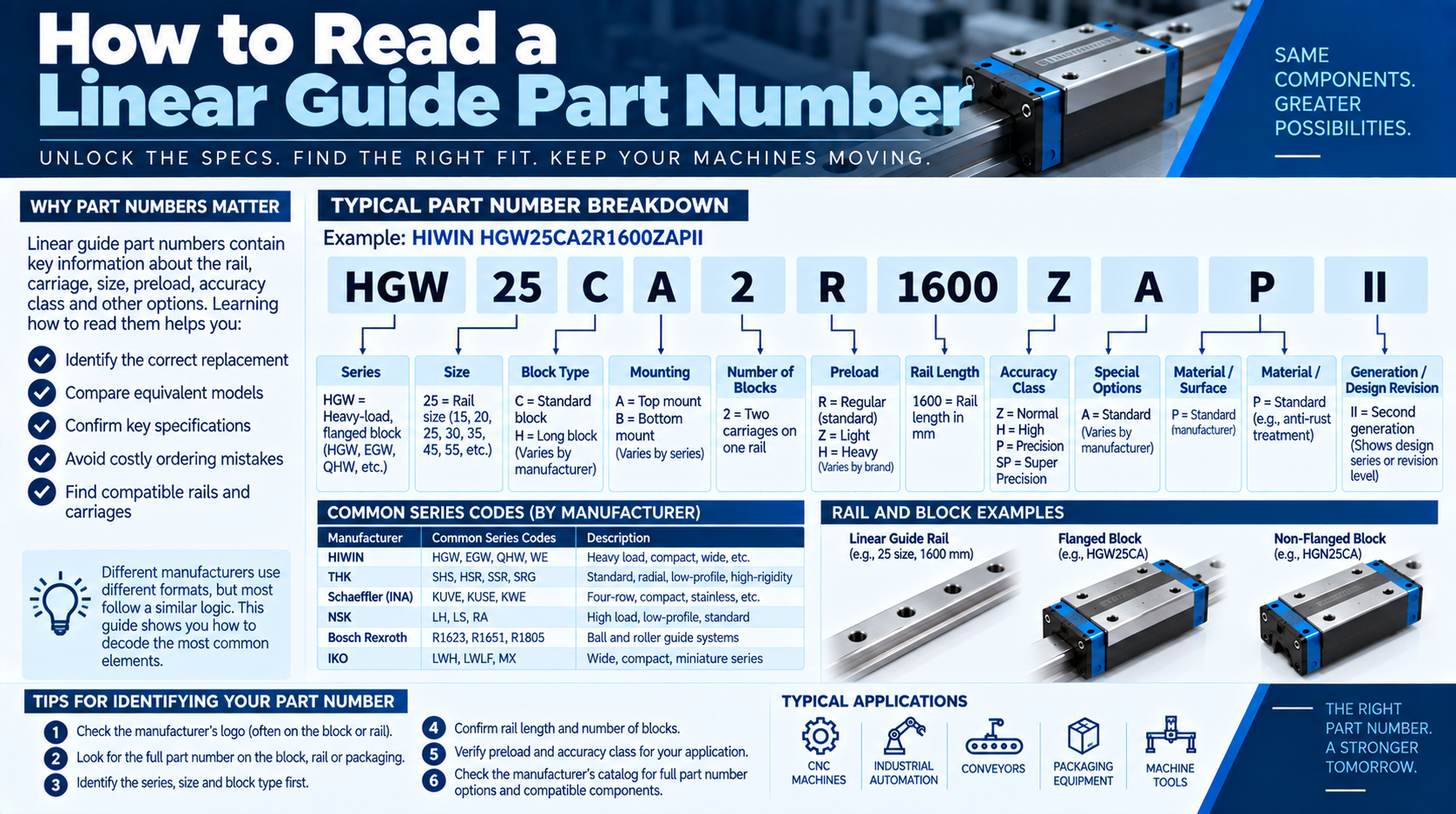
How to Read a Linear Guide Part Number
Learn how to read a linear guide part number and identify series, size, carriage style, preload, accuracy, seals, rail length, and replacement details.